Fleetboost at the Commercial Vehicle Future Day: Sector Coupling as the Key to the Transition to New Propulsion Systems
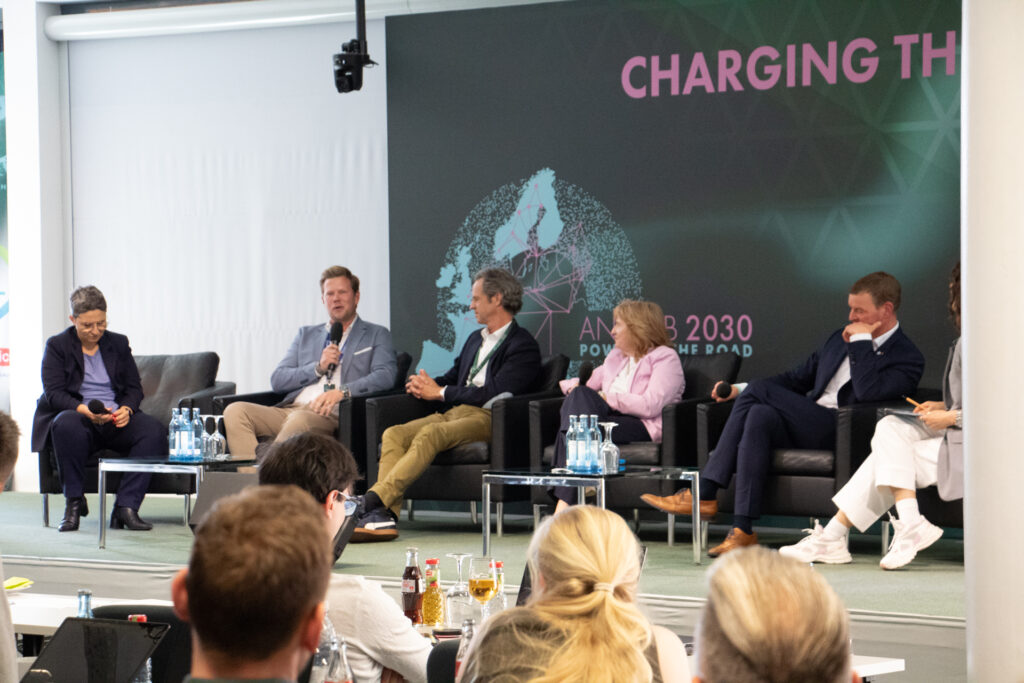
July 29, 2026 – Around 300 guests, electric trucks on the racetrack, and a clear message: The transition to electric propulsion in road freight transport is no longer being held back by vehicle technology—the decisive factors now are infrastructure, energy supply, and reliable regulatory conditions. That was the conclusion of the Commercial Vehicle Future Day at the DEKRA Lausitzring, hosted by the Federal Association of Road Freight Transport, Logistics, and Waste Management (BGL) e.V. and DEKRA on July 28. Fleetboost was right in the thick of it—on the panel, engaging in discussions, and sharing our vision of logistics that rethinks energy.
Frederik Rumpf on the podium: “How Can We Make the Transformation Happen?”
The highlight of the day for us was the main panel discussion on the question, “How can the transformation be achieved?” Our co-founder and CEO, Frederik Rumpf, participated in the discussion alongside Dr. Claudia Elif Stutz, State Secretary at the Federal Ministry of Transport; Maximilian von Löbbecke, Managing Director of Renault Trucks Germany; Sylvia Diederichsmeier, Head of Sales at Mercedes-Benz Trucks & FUSO; and Prof. Dr. Dirk Engelhardt, Spokesperson for the Executive Board of the BGL. The discussion was moderated by Claudia Bechstein.
Frederik’s key message: The transition to sustainable mobility will only succeed if the energy and logistics sectors work more closely together. Fleetboost is working precisely on this sector coupling—with mobile battery storage systems, charging stations, and energy management in 20- and 40-foot containers that can also be charged via the low-voltage grid and, for example, make electricity from wind and solar power plants directly available to the logistics sector. All too often, renewable energy generation still has to be curtailed because there are no consumers. Our mobile storage technology solves this problem: “This allows us to provide electricity wherever and whenever it’s needed,” says Frederik Rumpf.
The Key Takeaways of the Day
A common theme emerged across all the presentations and discussions. Battery-electric trucks are already economically viable in many operating scenarios today—in some cases significantly cheaper to operate than diesel trucks, especially when trucking companies combine charging at their depots with their own solar power systems. However, for these individual successes to evolve into a scalable model for small and medium-sized businesses, grid connections, charging capacity, energy prices, and route planning must come together to form a viable overall system. Above all, participants called for predictability through long-term policy frameworks, faster grid connections, and better integration of depot and public charging infrastructure.
Policymakers provided specific figures on this: The fast-charging network for trucks along the highways, comprising 350 locations, is currently out for bid; by 2030, there is to be a charging station every 60 kilometers on the core network. In addition, the federal government is providing one billion euros in funding over the next four years for charging infrastructure at transport companies’ depots.
For us, all of this serves as confirmation: It is precisely at the intersection of renewable energy generation and fleet energy needs that the industry finds the lever it needs right now—and that Fleetboost provides.
Hands-On Technology
Visitors to the Lausitzring were able to experience firsthand just how far this development has come: In the Innovation Hub, numerous exhibitors showcased the latest vehicles and solutions related to charging infrastructure, battery technology, and energy supply; electric trucks completed laps on the racetrack; and the DEKRA Battery Test Center provided insights into how battery systems are tested under extreme conditions.
Our Thanks
We would like to thank the BGL and DEKRA for their excellent organization, and all our discussion partners for the open exchange of ideas. The dialogue between policymakers, manufacturers, the energy sector, and the transportation industry has shown that we are heading in the right direction—now it’s time to move forward with implementation. We look forward to continuing to drive the transition to new propulsion systems forward together.
For more information about the event, visit https://www.antrieb2030.de/.
Would you like to learn more about how FleetBoost delivers renewable energy to where fleets need it? Contact us.