New BMV grant for electric truck charging infrastructure: Get up to €445,000 in funding with FleetBoost!
The development of a robust charging infrastructure is a key prerequisite for the successful transition to battery-electric trucks. The Federal Ministry of Transport’s new funding guidelines are now providing additional momentum for this expansion: Over the next four years, the federal government will allocate a total of one billion euros for charging infrastructure for heavy-duty commercial vehicles.
Federal Minister of Transportation Patrick Schnieder emphasizes:
“[…] With our multi-billion-euro subsidy program, we are now laying the groundwork for the rapid expansion of the charging infrastructure and making it easier for freight forwarders and logistics companies to switch to battery-electric commercial vehicles. […]”
Funding is available for, among other things, charging points not open to the public at vehicle depots, storage facilities, and logistics sites, as well as publicly accessible charging infrastructure. In addition to the charging infrastructure itself, grid connections, charging, load, and energy management systems, as well as battery storage, may also be considered, provided they are technically necessary for the operation of the charging infrastructure.
FleetBooster: Up to €445,000 in funding is theoretically possible
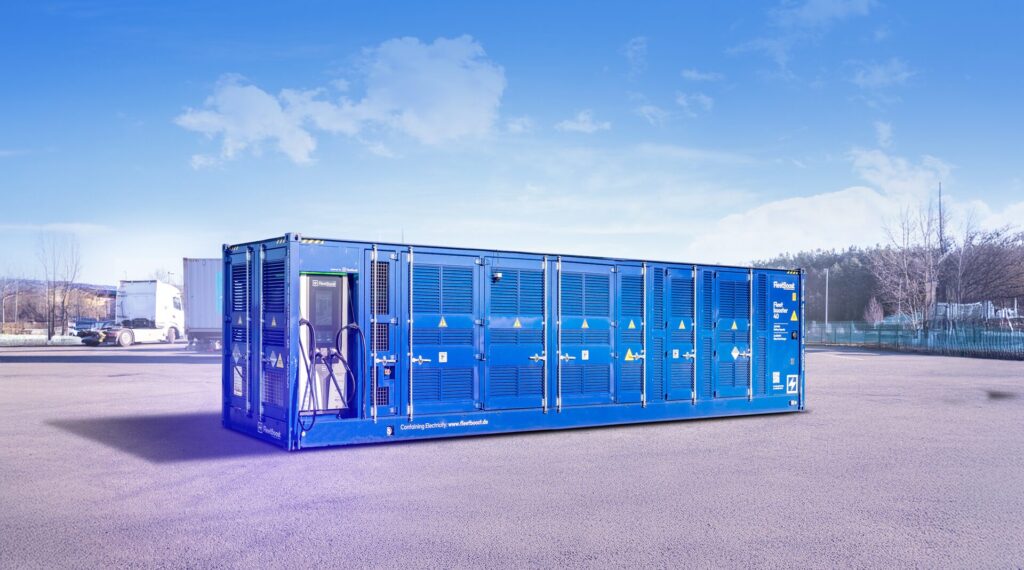
This is exactly where FleetBoost comes in: As a stationary solution, the FleetBooster can help make more efficient use of existing grid connections and provide additional charging capacity for electric trucks. Especially at locations with limited grid capacity or long lead times for grid expansion, the combination of battery storage, charging capacity, and intelligent energy management offers a practical solution.
This means that, as part of a suitable site concept, the FleetBooster can generally be considered a component of an eligible charging infrastructure project. With up to 400 kW of charging power for the FleetBooster 20 and up to 800 kW for the FleetBooster 40, the solution significantly exceeds the minimum requirements of the funding calls. At the same time, the integrated battery storage system can help make more efficient use of available grid power and provide additional charging capacity even at locations where traditional grid expansion involves longer lead times.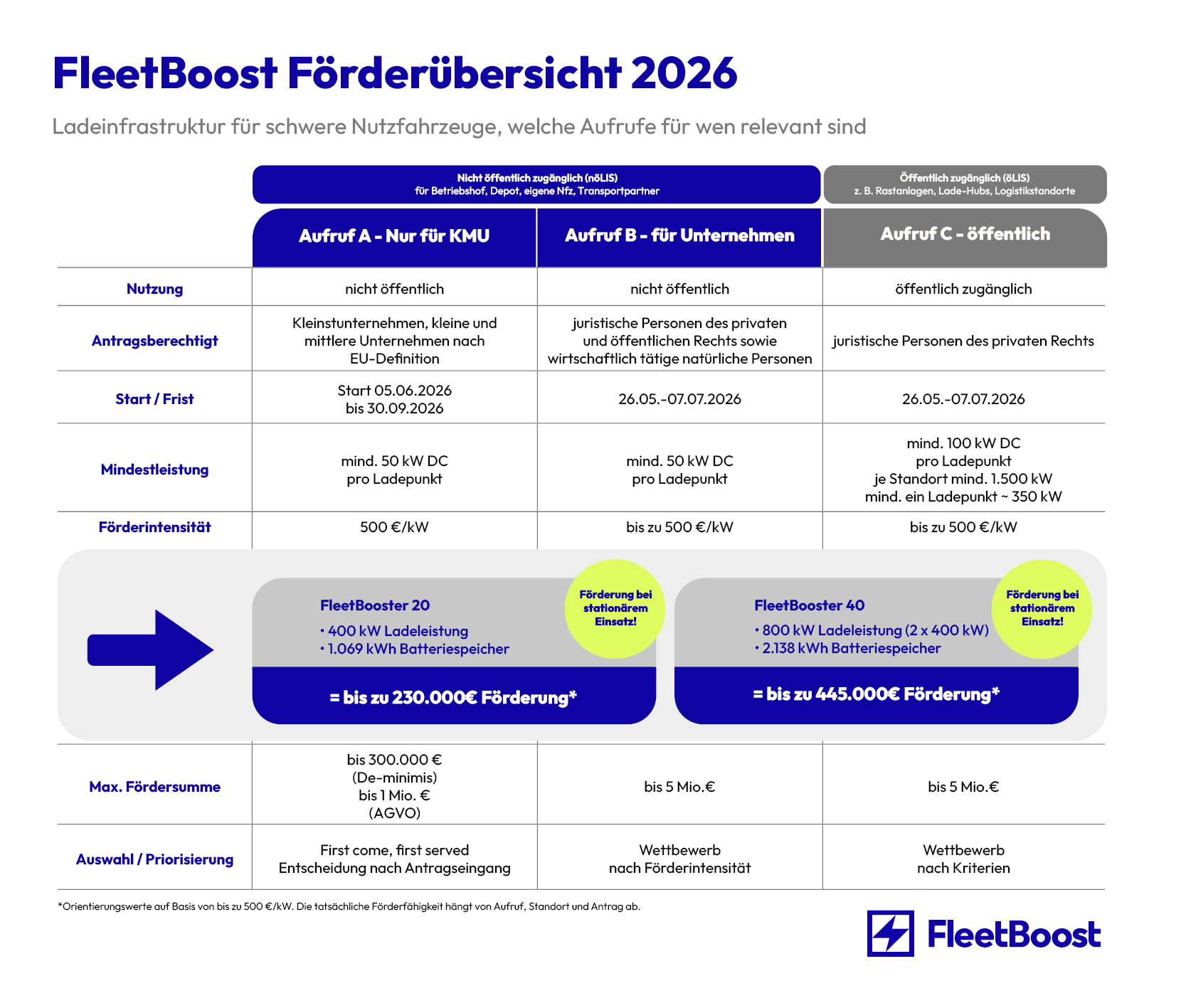
Further information on funding
For more details on current funding calls, application deadlines, and eligibility requirements, please visit the official information pages:
Federal Ministry of Transport
Official press release on new funding for heavy-duty vehicle charging infrastructure.
Link: https://www.bmv.de/SharedDocs/DE/Pressemitteilungen/2026/036-schnieder-foerderung-ladeinfrastruktur-schwere-nutzfahrzeuge.html
National Charging Infrastructure Coordination Center
Overview of funding opportunities and classification of current calls for proposals.
Link: https://nationale-leitstelle.de/eine-milliarde-euro-fuer-den-aufbau-von-ladeinfrastruktur-fuer-schwere-nutzfahrzeuge/
Project Management Jülich (PtJ)
Official information on funding calls, application procedures, and technical requirements.
Link: https://www.ptj.de/foerdermoeglichkeiten/lis-e-lkw
NOW GmbH – Funding Finder
Additional overview of funding opportunities and relevant deadlines.
Link: https://www.now-gmbh.de/foerderung/foerderfinder/ladeinfrastruktur-fuer-schwere-nutzfahrzeuge/
Note: Applications are governed exclusively by the current funding guidelines and documentation provided by the official funding agencies. The information provided is subject to change without notice.